

EMS Air Ambulance Case: $150,000 Lost in Legal Traps
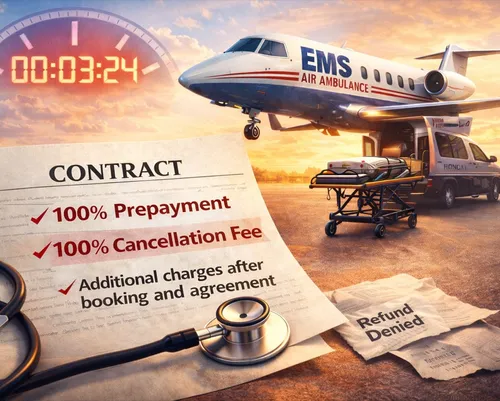
When a loved one requires urgent medical evacuation, families are often forced to act fast — emotionally and financially. In July 2024, one such family contracted EMS Air Ambulance & Medical Repatriation Ltd, a UK-based company offering bedside-to-bedside repatriation. What followed was not just a logistical failure — it was a masterclass in how carefully drafted contracts can trap vulnerable clients and make recovery of funds nearly impossible.
This article outlines the timeline of events, the hidden mechanisms within EMS’s contracts, and the jurisdictional maze clients face when trying to assert their rights. EMS continues to promote its services aggressively across digital platforms, while refusing to return $150,000 for a service it fundamentally failed to deliver. This case serves as a warning for brokers, hospitals, operators, and — most importantly — families.
Timeline of Events
- 30 July 2024, 11:08: EMS representative confirms: “Everything is in order” — pushing for immediate payment.
- 11:15: Payment of $150,000 is sent.
- 16:03: EMS issues "Booking Confirmation" — contract clause 5.4.5 activates, making the payment non-refundable.
- 19:05: EMS announces that passenger transport (a key condition) is not possible, despite earlier confirmation.
Contract Clauses: Built-In Risks
- Passenger Transport Included in Agreement: The signed quotation and agreement explicitly included transport for two co-passengers alongside the patient — a critical term that was acknowledged and priced into the contract.
- Clause 5.4.5 – 100% Cancellation Fee After Booking Confirmation: Once the booking is confirmed, no refund is entertained:
“100% cancellation fee is applicable once the Booking Confirmation has been sent... no requests for any refund shall be entertained.”
- Clause 3.4 – Broker Status & Disclaimed Responsibility: EMS operates as a broker, not a carrier, and refuses responsibility for delays or cancellations from the operator:
“In the event of any cancellation, delay or postponement, EMS shall not be liable as it is not the actual operator of the aircraft.”
- Clause 10.1 – Jurisdiction in Dubai: All disputes must be resolved via arbitration in DIAC (Dubai), drastically increasing costs and legal inaccessibility for clients.
Strategic Manipulations and Legal Design
Upon review, the structure of EMS’s contractual process reveals deliberate sequencing and asymmetry in obligations. The Booking Confirmation trap is particularly revealing: EMS first issues informal reassurance that “everything is in order” — effectively prompting payment. Within hours, they send an automated confirmation email that, according to their clause 5.4.5, locks in the full cancellation penalty. Only after this legal trigger is pulled does EMS inform the client that the two passenger seats — a key contractual element — are no longer possible due to aircraft limitations or medical concerns. At this point, the client's money is already contractually forfeited.
When challenged, EMS presents new “options” — a classic surcharge scheme. Clients are asked to pay $64,850 for one co-passenger or $87,500 for two, which were already included in the original price. This pressure tactic is reinforced by vague medical recommendations, citing the need for a different aircraft or intubation, all post-payment. These escalations are not safety-driven upgrades but financial pivots dressed as medical prudence.
Further complicating matters is EMS’s use of geographical dispersion. The company is registered in the UK, collects funds via a U.S. bank, and demands legal proceedings take place in the UAE. This fragmented structure effectively shields the company behind jurisdictional friction. Even if a UK court ruled in a client’s favor, enforcing a judgment across multiple borders — especially into a U.S. financial institution — would be prohibitively expensive and time-consuming. Meanwhile, clause 3.4 allows EMS to defer operational liability to the actual carrier, despite acting as the contracting party for the patient and their family.
The overall design, both in communication and legal drafting, suggests a pattern optimized not for client safety or satisfaction, but for transactional finality — where any service deviation becomes a client burden, and refund claims are systematically neutralized. Combined with emotionally charged circumstances — ICU cases, cross-border urgency — this approach positions EMS to extract maximum financial commitment with minimal recourse.
This pattern is not isolated. Public complaints describe similar tactics: sudden surcharges post-payment, last-minute cancellations without refund, and refusal to reimburse despite non-performance. In at least one legal dispute in the Netherlands, EMS was ordered to return a significant portion of a cancelled contract. These recurring issues suggest a broader strategy rather than an operational anomaly.
This case reveals how a medical repatriation contract can be legally structured to:
- Take full payment upfront
- Shift responsibility to 3rd parties
- Deny refunds with a single email
- Make legal pursuit practically impossible
BLACKLIST.AERO strongly advises against any cooperation with EMS Air Ambulance & Medical Repatriation Ltd until this case is resolved and all affected funds are returned. We urge patients, brokers, hospitals, and operators to study contracts in detail, verify who owns responsibility, and always clarify refund policies before transferring funds — especially in high-stress medical situations.
Furthermore, we recommend that EMS urgently revises its contractual model — particularly the 100% cancellation penalty applied before service terms are practically verified — to ensure fairness and transparency for future clients.
Alex Melnychenko, Operations Director at BLACKLIST.AERO
 The Nano Jets case appears to be a textbook example of alleged fraud within the aviation industry. Following the outbreak of missile attacks launched by Iran against several Middle Eastern countries, demand for evacuation flights increased dramatically. Various opportunists and alleged scammers immediately attempted to exploit the situation, among them an individual named Orkhan Pirverdiyev and his company, Nano Jets.
 After the European Business Aviation Association announced the cancellation of the EBACE 2026 exhibition, even the laziest observers said—either publicly or to themselves—“We warned you!”, addressing the organizers. At the same time, the frustration over losing the exhibition as a nostalgic symbol of business aviation mixed equally with anger that market participants had not been heard and were forced to protest with their wallets.
 Two years prior to its bankruptcy, SIA SmartLynx Airlines (Latvia) issued an unsecured loan to the Lithuanian company UAB Portlite. This information follows from a letter sent to creditors by the official insolvency administrator of SIA SmartLynx Airlines, Marija Mišina. The editorial team of BLACKLIST.AERO has obtained a copy of this letter.
 According to information obtained by the editorial team of the BLACKLIST.AERO registry, Harmony Jets and Harmony Aircraft Services have completely ceased operations.
